My Personal Project (SOLO)
Crisis Beyond

Crisis Beyond is a 2D alchemic survival game set during a historical apocalypse, developed in Unity. The narrative draws inspiration from the Great Plague of Seville (1647–1652), grounding the experience in real historical events, while the crafting mechanics take cues from a game, Potion Craft and authentic 17th-century Western alchemical practices.
The game was solo developed over the course of 6 months (2 semesters), with valuable assistance, guidance, and feedback provided by 3 of my course lecturers throughout its development.
The game follows the journey of a young boy in a plague-stricken coastal city, where survival itself is uncertain. After the departure of his parents, his only remaining family—his sister—succumbs to the deadly plague, placing him at the heart of a desperate struggle.
The boy's turning point comes with the discovery of an ancient alchemy book, a relic filled with forgotten recipes that hold the potential to fight the disease. This discovery becomes the foundation of the game’s core mechanic: alchemy as progression.
Venture into the wilds to scavenge for herbs, then experiment through alchemical crafting to unlock cures. Within a 10-day countdown, where each choice—how to spend time and which recipes to pursue—directly determines whether the boy can save his sister before the plague claims her life.
Design Concept Overview
Game Core Loop
Gather Herbs
Create Herbal Parts
Create Potion
Feed Potion to Cure
Players gather herbs from both the home garden and the surrounding wilds, then refine them into alchemical preparations such as extracts, tinctures, volatile oils, and essential oils. These preparations are further coagulated into functional potions that serve as cures. The ultimate goal is to craft the correct remedies and administer them to the boy’s sister, restoring her health from the grip of the Black Death.
Mechanic/ Features
Real-life Herbals
-
8 authentic antibacterial herbs to scavenge for potion-making.
-
Players can harvest up to 5 herbs daily from the wilds through Quick Time Event (QTE) gathering.
-
Garden-grown herbs offer mature harvests but require time to regrow.
-
Each herb’s function is grounded in real-life antibacterial properties, adding an educational layer.
-
Certain herbs carry efficacy conflicts, requiring careful crafting decisions.
-
Garlic + Lavender
-
Thyme + Sage
-
Alchemy Craft
-
Herbs undergo step-by-step preparation before becoming usable preparations.
-
Clean Garlic → Dried Garlic → Garlic Extract
-
Clean Garlic → Garlic Powder → Garlic Tincture
-
-
Preparations are combined into combination of functional potions, with efficacy conflicts influencing success.
Action Management
-
Player must balance daily actions:
-
Scavenging herbs (wilds or garden)
-
Preparing herbal parts
-
Crafting potions
-
Treating the sister
-
Resting to pass the day
-
Time Management
-
The player has 10 in-game days to cure the sister’s plague infection, creating urgency and tension in everyday decision.
Development Progression
Before diving into my design progression, I’d like to share the inspirations behind Crisis Beyond. As a passionate fan of apocalypse-themed games and 2D pixel art, I infused the project with systems of resource management, crafting, and hand-drawn visuals created in Aseprite throughout development.
The concept draws inspiration from biblical motifs such as Beelzebub and the Four Horsemen of the Apocalypse, alongside my personal fascination with plague narratives. Motivated by a promise to my mother to pursue game development meaningfully, I set out to design a game that could also provide educational value. This led me to ground the narrative in the real history of the Great Plague of Seville and to integrate alchemy mechanics inspired by 17th-century practices. Using real antibacterial herbs as crafting ingredients, the game connects historical knowledge with interactive gameplay, blending authenticity with creativity.
Player can gather herbs from the wilds or harvest mature plants from the house garden. Initially, I planned for 20 herbal types, but due to time constraints and the excessive volume of artwork required within six months, I scaled this down to 8 core herbs—each chosen for their historical and antibacterial relevance.
I also had an early fore-design for the harvesting mechanics where the player would occasionally encounter patients while exploring the wilds. The idea was that player could use prepared potions to cure these patients and receive in-game currency as a reward. However, this design was ultimately not applied in the game.
In the crafting mechanics, player can process collected herbs into precursors that serve as the basis for potion alchemy. Within the potion-making system, I implemented several steps inspired by real alchemical practices—such as drying, grinding, macerating, tincturing, infusing, and distilling.
Before entering production, I initially designed a far more complex, step-by-step system that closely followed real-life methods of herbal preparation. However, this quickly became an issue of overscoping, as it demanded a significant amount of additional artwork, coding, and development time. To ensure the project’s completion, I streamlined the process during production while keeping the historical essence intact.
While the crafted potions do not replicate real medicine for the Black Death, they were designed to capture the spirit of 17th-century alchemy and serve the gameplay needs of the project.
Initially, I aimed to design the game around an Action Point (AP) system inspired by Terminus: Zombie Survivors. Every in-game action—exploring, harvesting, crafting, and feeding the sister—would consume AP, with a strict daily limit. Exploration was restricted to daytime, while a merchant character could only be encountered at night. However, this entire system was abandoned at the start of production to streamline scope and focus development efforts.
Furthermore, I had also designed a store mechanic during the concept phase to enrich the gameplay experience. For example, player could purchase a Hand Fork for 1000 currency to increase herb collection, buy special herbs with stronger effects, or sell excess herbs for extra earnings. However, this mechanic was eventually cancelled and not applied in the final game.
Art & Genre Direction
After finalizing the game design concept, I began creating all the game art assets personally using Aseprite. These assets were iteratively refined throughout development to improve the visual clarity and overall player experience. You can refer to the My Art section below for samples of the completed works.
Story-Driven Game Goal
The game is built around a narrative arc that unfolds from the plague’s origin in a coastal city to the boy’s transformation into a plague doctor. The player’s ultimate goal is to save his sister from the Black Death within a strict 10-day timeframe. Success or failure is determined by how effectively the player manages time, resources, and alchemical knowledge throughout the journey.
QTE Harvest Design
The harvesting system in the wilds was designed around a Quick Time Event (QTE) mechanic. Each time the player attempts to gather herbs, a QTE is triggered to determine whether the harvest is successful or fails. A successful harvest rewards the player with the targeted herb, while failure results in no gain, emphasizing timing and precision during resource collection.
Crafting Action Point
Certain crafting actions consume Action Points (AP), creating a layer of resource management for the player. With AP being limited, the player must carefully plan, prioritize, and balance their choices. This system encourages strategic thinking and forces meaningful trade-offs to reach the ultimate goal of curing the sister.
In-Game Scenes

< Main Menu Scene >
Main Menu features a Start button that leads into the story scenes and a Quit button that exits the game. As the project remains in development, a 'Still In Dev...' label is displayed beneath the game title to indicate its unfinished state due to my programming issues.

< Story 01 Scene >

< Story 02 Scene >

< Story 03 Scene >
The 3 Story Scenes contain 6 narrative segments, presenting the boy’s journey from the beginning of the tale through the key moments of his struggle to save his sister.

< Hub Scene #1 >

< Hub Scene #2 >
The Hub Scene features a calendar that tracks the current day and serves as the countdown to the sister’s potential death. It also includes five interactive buttons—Alchemy Station, Explore, Garden, Sister’s Room, and Sleep—each granting access to different scenes that drive gameplay progression and discovery.

< Processing Chamber 01 Scene >

< Processing Chamber 02 Scene >

< P.C Hints 01 Scene >

< P.C Hints 02 Scene >
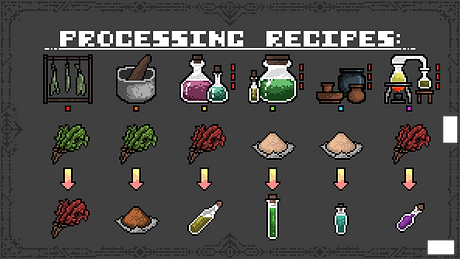
Processing Chamber Scene allows player to convert collected herbs into various preparations, including extracts, tinctures, volatile oils, and essential oils, along with dried and powdered herbs as precursors for advanced crafting. Each preparation requires Action Points (AP) to perform, adding a layer of resource management. Additional guidance is provided through crafting notes, help the player making informed choices during the preparation process.

< Athanor Scene >

< Athanor Hints 01 Scene >

< Athanor Hints 02 Scene >

< Athanor Hints 03 Scene >
The Athanor Scene is the core crafting space, where player can coagulates herbal preparations into potions of varying levels using sufficient action point (AP). However, efficacy conflicts between ingredients must be carefully managed to avoid negative outcomes. Additional details are provided in the crafting notes, guiding player to make informed decisions during potion creation.

< Wilds Map Scene #1 >

< Wilds Map Scene #2 >
< Wilds Map Scene #3 >
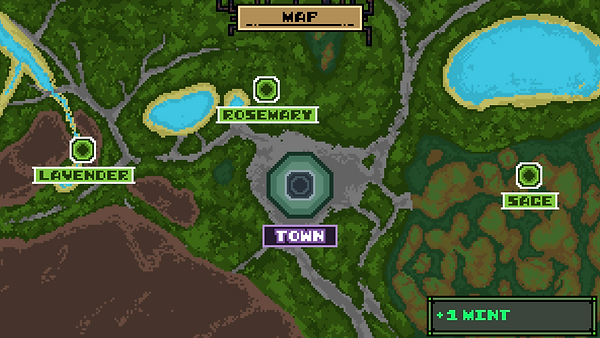
The Wilds provide up to 6 different herbs from the 8 for harvesting each day, serving as a regulated resource output. Player can return to town (the Hub Scene) via a dedicated button. Herb gathering is tied to a Quick Time Event (QTE) minigame, where successful inputs reward the player with herbs and trigger a UI gathering note for added visual feedback.

< Sister's Room Scene #1 >

< Sister's Room Scene #2 >

< Sister's Room Scene #3 >

< S.R Hints Scene >
The Sister’s Room Scene serves as the central interface for tracking the sister’s condition. It displays her current illness level, the available crafted potions, and guidance notes on treatment. To maintain balance, the sister has a daily potion consumption limit, requiring player to carefully plan which remedies to administer each day.

< Garden Scene >
Garden contains 8 interactable herbs of either mature of grown that can be harvested for extra gain rather than just exploring around the wilds for permanent herb gathering daily. An UI gathering note will be shown for their visual feedback.

< Good End Scene >

< Bad End Scene >
The game features two distinct endings—Good or Bad—determined by whether the player successfully cures the sister within the 10-day time limit.

< Sleep Scene >
Selecting the Sleep button in the Hub Scene transitions the player to the Sleep Scene, where the day advances and Action Points (AP) are reset across the Processing Chamber, Athanor, and Sister’s Room.
My Art

< General Arts created for Scene Artwork Usage >
The majority of the artwork presented here was designed as interactive UI buttons and functional visual overlays. Their applications and effects will be demonstrated in detail in the upcoming sections. Whereas the player character's art is inspired by hectormay47 in Pinterest.

< All the 8 Herbs and their Preparations >

< 6 Potions of Different Level for Different Illness Level >
Each potion follows a rainbow color scheme, with every color corresponding to a specific stage of illness severity.

< Main Menu - Scene 01 >

< Story 02 - Scene 03 >

< Hub - Scene 05 >

< Processing Chamber 02 - Scene 07 >

< P.C Hints 02 - Scene 09 >

< Story 01 - Scene 02 >

< Story 03 - Scene 04 >

< Processing Chamber 01 - Scene 06 >
< P.C Hints 01 - Scene 08 >

< Athanor - Scene 10 >

< Athanor Hints 01 - Scene 11 >

< Athanor Hints 03 - Scene 13 >

< Sister's Room - Scene 15 >

< Garden - Scene 17 >

< Ending Bad - Scene 19 >

< Athanor Hints 02 - Scene 12 >

< Wilds Map - Scene 14 >

< S.R Hints - Scene 16 >

< Ending Good - Scene 18 >

< Sleep - Scene 20 >
All 20 scene artworks were hand-crafted in Aseprite, serving as atmospheric visuals that enrich the game world, intentionally kept free of interactable elements.

< UI Artworks on Scene 01 >

< UI Artworks on Scene 05 >

< UI Artworks on Scene 14 >

< UI Artworks on Scene 17 >

< UI Artworks on Scene 02 - 04 >

< UI Artworks on Scene 06 - 13 >

< UI Artworks on Scene 15 - 16 >

< UI Artworks on Scene 18 - 19 >
Every UI artwork displayed in the images showcases the interactive buttons and supplemental elements integrated into the game scenes, supporting functionality and player interaction throughout gameplay.